

Introduction
In seawater desalination, recovery is defined as the ratio of permeate flow rate to system feed flow rate. In reverse osmosis (RO) seawater desalination, the optimal recovery rate corresponds to the scenario where the total cost of seawater desalination for a specific project is minimized. A higher recovery rate results in lower capital costs but higher operating costs, the latter due to increased energy consumption caused by the higher salinity of the concentrate. A lower recovery rate leads to lower energy consumption but higher capital costs, as larger equipment is required to produce a given volume of permeate, resulting in higher expenses.
For most seawater reverse osmosis (SWRO) plants, the minimum total water production cost is achieved at a recovery rate between 40% and 45%. However, higher recovery rates are required for SWRO plants where feed water intake or brine discharge is limited or costly, pretreatment is expensive or difficult, or capital and equipment costs are high. For existing SWRO plants, increasing the brine concentration can raise the recovery rate and produce more permeate without expanding feed water or pretreatment capacity.
At present, high-recovery seawater desalination is technically feasible and can generate substantial capital cost savings.
Overview
The traditional method for brine concentration is thermal evaporation. However, the capital costs and energy consumption of thermal evaporation are prohibitively high for many applications. This section discusses strategies for achieving high brine concentration using reverse osmosis membranes to attain high recovery rates.
Limiting Factors for Scaling
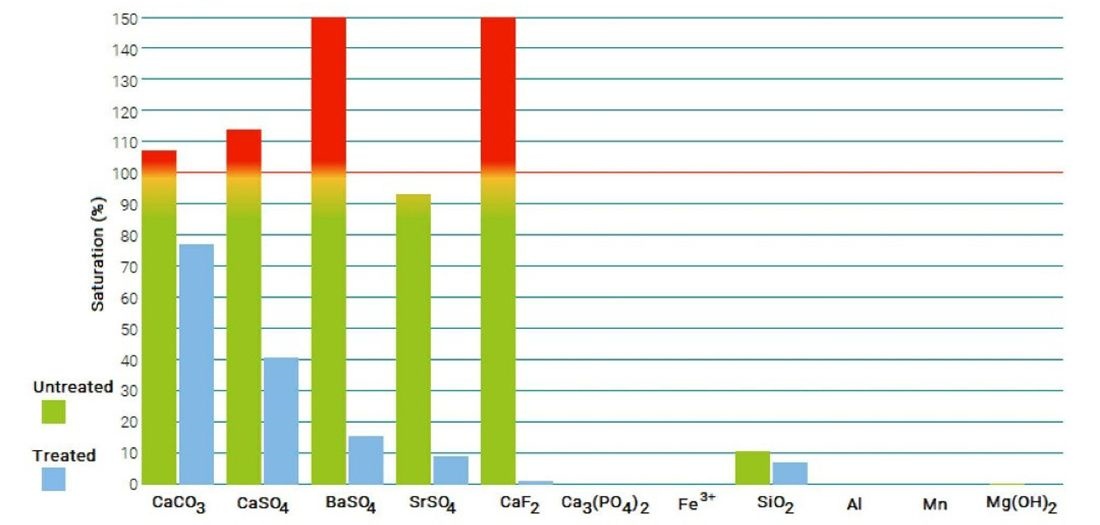
At high brine concentrations, there is a potential risk of precipitation of sparingly soluble salts on the membrane surface (i.e., scaling). Figure 1 is a scaling inhibitor dosage prediction chart showing the saturation percentages of major salts in seawater with a total dissolved solids (TDS) concentration of 130 g/L [1]. The chart indicates that scaling can be avoided through standard scaling inhibitor dosing and feed water pH neutralization.
Osmotically Assisted Reverse Osmosis In conventional reverse osmosis, the feed pressure increases with a higher recovery rate, since the osmotic pressure of the RO permeate can be neglected. However, if the permeate has a relatively high salt content, the required feed pressure is proportional to the osmotic pressure difference between the feed and the permeate. Osmotically Assisted Reverse Osmosis (OARO) takes advantage of this phenomenon, enabling the production of ultra-high concentration brine at relatively low feed pressures. OARO membranes, also referred to as Low Salt Rejection Reverse Osmosis (LSSRO) membranes, allow high salt passage [2]. They share the same spiral-wound configuration as standard seawater reverse osmosis (SWRO) membranes and are arranged in a multi-stage setup, where a greater number of stages results in a higher concentration factor. Nevertheless, the cascading arrangement of OARO differs from that of conventional multi-stage reverse osmosis (RO), as illustrated in the figure below. In the traditional multi-stage RO process shown in Figure 2, one or more interstage pumps are used to elevate the feed pressure to overcome the rising osmotic pressure in the concentrated feed stream. While effective, this approach is constrained by the maximum pressure resistance of RO membranes and equipment, and requires interstage pumps capable of withstanding high pressures.
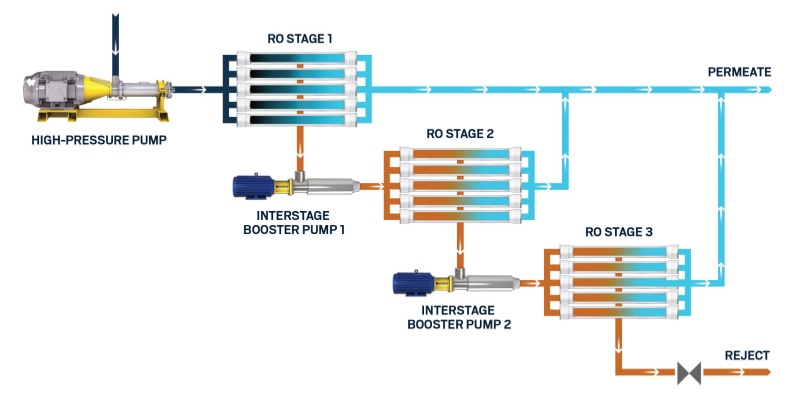
RO process with interstage boosting
RO process with interstage boosting
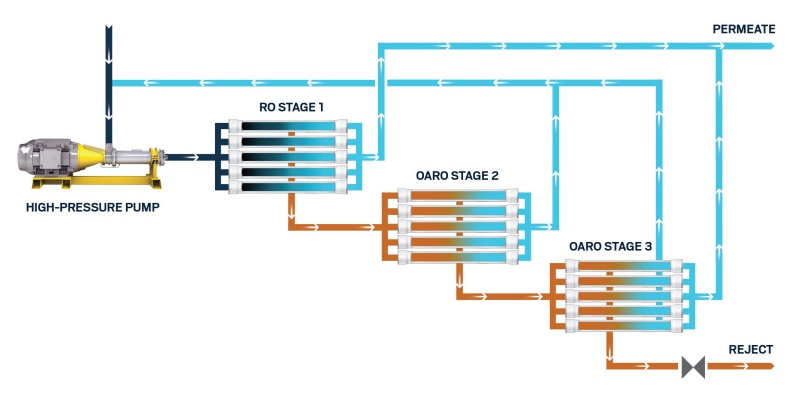
Figure 3 – OARO Process without Interstage Boosting
In the OARO process shown in Figure 3, the feed pressure does not increase between successive stages. Pressure decreases slightly in each consecutive stage due to hydraulic resistance (commonly referred to as pressure drop) in the feed/concentrate channels. Accordingly, OARO membranes with higher permeability and lower salt rejection should be selected for downstream stages where the feed salinity is higher. This concept is similar to the internal staging or mixed design commonly used in RO systems, in which "tighter" membranes are employed at the vessel front end and "looser" membranes at the tail end [3]. The saline permeate from the OARO concentration stages is directed to the upstream stages. Proper arrangement of membrane types in the OARO array creates a permeability ramp that balances flux and maximizes concentration per stage, while minimizing the volume of saline permeate recycled within the process. Besides eliminating the need for interstage booster pumps, OARO systems also optimize the use of high-efficiency isobaric energy recovery devices, such as the PX® Pressure Exchanger® (PX) from Energy Recovery Inc., described below.
By employing Energy Recovery’s PX technology, OARO enables efficient, high-recovery, high-pressure multi-stage reverse osmosis without costly interstage boosting.
Comparison with Conventional Seawater Reverse Osmosis Technology
How do these costs compare to those of typical single-stage seawater reverse osmosis (SWRO) desalination? While the above analysis focuses on RO equipment, process flows at different recovery rates must account for auxiliary facilities, including intake, outfall, and pretreatment. Global Water Intelligence (GWI) [5] provides capital and operating cost data for conventional desalination plants. The calculated specific energy consumption is 2.3 kWh per cubic meter of permeate [6, 7], of which 0.8 kWh/m³ is attributed to intake and pretreatment.
The two lowest-cost high-recovery scenarios mentioned above (both employing OARO and PX ERD) are compared with a 45% recovery SWRO scenario using PX ERD in Table 4 below. As expected, the high-recovery scenarios incur higher energy consumption but lower capital expenditure (CAPEX) than the low-recovery scenario, with a net 10% higher total unit permeate cost for concentrated brine. However, since SWRO concentrate brine requires no additional intake, discharge, or pretreatment, its unit cost is equivalent to that of conventional SWRO. This suggests that brine concentration can be a viable approach to increase permeate production without constructing new primary RO plants. Furthermore, brine concentration plant retrofits can be implemented much faster than new-build facilities due to less infrastructure required.
Since SWRO brine requires no capital or operating costs for intake or pretreatment, its desalination cost is identical to that of seawater desalination.
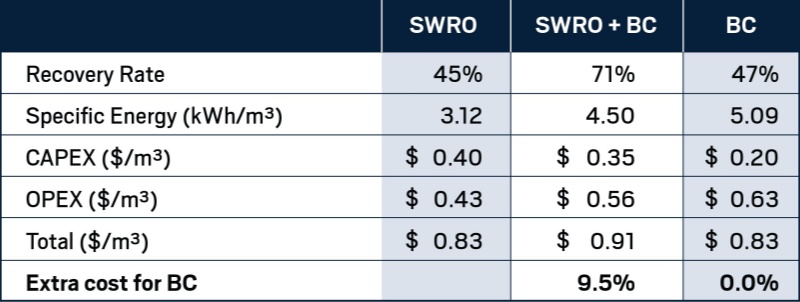
Table 4 – Cost Comparison of High‑Recovery Alternatives with Conventional Seawater Reverse Osmosis Using PX
Economic trends that drive up infrastructure costs—such as rising interest rates, increasing material costs, or material shortages—will further favor the design and operation of seawater reverse osmosis (SWRO) systems with higher recovery rates. Similarly, regions with lower electricity prices or plants able to utilize low-cost photovoltaic solar power may find high-recovery SWRO or highly concentrated SWRO brine streams economically more advantageous. Conclusions The analysis demonstrates that high-recovery seawater reverse osmosis (SWRO) employing PX energy recovery devices reduces the total water production cost by 14–20% compared to systems utilizing two turbochargers. Furthermore, the results show that the total water production cost using OARO technology is significantly lower than that of UHPRO, mainly due to the substantial energy savings achieved by PX energy recovery devices. Although SWRO has higher energy consumption, its concentration cost is comparable to seawater desalination while avoiding much of the infrastructure expense, and can enable faster implementation. These findings strongly demonstrate the advantages of high-recovery SWRO in both new and existing desalination projects, especially in regions with high capital costs, cumbersome or expensive intake, outfall, or pretreatment facilities, and low-cost electricity.