

Nitrogen is one of the most prevalent environmental pollutants in wastewater, originating from domestic sewage, industrial effluent, and agricultural livestock breeding wastewater, among other sources. Excessive nitrogen discharge can lead to severe problems such as water hypoxia, blackening and odorization, and even eutrophication. The use of microbial technology is one of the most economical and effective approaches to address nitrogen pollution. As a core technology in sewage treatment, the traditional biological nitrogen removal process utilizes ammonia-oxidizing bacteria (AOB), nitrite-oxidizing bacteria (NOB), and denitrifying bacteria (DNB) to convert ammonia nitrogen in wastewater into nitrogen gas through nitrification and denitrification. It is currently a widely adopted process in the secondary treatment systems of sewage treatment plants both domestically and internationally.
However, with the rapid development of industrialization and urbanization, the emergence of various emerging pollutants—such as persistent organic pollutants, pharmaceuticals and personal care products (PPCPs), and endocrine-disrupting chemicals—has posed severe challenges to biological sewage treatment systems. These pollutants are not only difficult to remove via conventional processes, but their interactions with microorganisms are also likely to trigger a series of chain reactions, including metabolic disorders of nitrifying bacteria communities and alterations in functional gene expression, resulting in a continuous decline in the stability and shock resistance of nitrogen removal systems in sewage treatment.
In recent years, microplastics (MPs), as a representative of emerging pollutants, have attracted widespread attention worldwide due to their detrimental effects on aquatic environments and sewage treatment systems. Studies have shown that MPs may exhibit certain microbial toxic inhibitory effects, thereby deteriorating the nitrogen removal efficiency of activated sludge. Nevertheless, other studies have indicated that as inert carriers, MPs can provide favorable attachment sites for microorganisms, thus increasing the mass transfer area between microorganisms and substrates, and exerting a beneficial effect on biological nitrogen removal. This contradictory characteristic often depends on the coupling of the inherent physicochemical properties of the pollutants, their environmental occurrence states, and the process operating conditions. Current research urgently needs to elucidate the interaction mechanisms between emerging pollutants and functional microorganisms from multiple dimensions, so as to provide theoretical support for enhancing the capacity of sewage treatment systems to cope with composite pollution.
1. Occurrence of MPs in Sewage Treatment Plants
Since industrial effluent and domestic sewage contain substantial amounts of MPs, which are discharged into sewage treatment plants via sewer pipes and underground pipe networks, sewage treatment plants are regarded as an important sink of MPs. Table 1 summarizes domestic and international literature reports on the occurrence of MPs in sewage treatment plants in recent years. It can be seen that the dominant type of MPs in sewage treatment plants is fibers, followed by a small quantity of fragments and particles, among which fibers are mainly derived from household laundry and the use of personal care products. In addition, polyethylene (PE), polypropylene (PP), polyethylene terephthalate (PET) and polyamide (PA) are the common types of MPs in the influent of sewage treatment plants. Among these, PE is the most widely used plastic globally, and is primarily applied in daily necessities and food packaging films. PA is extensively utilized in the production of fabrics and wear-resistant components due to its high strength and excellent wear resistance. As an early-developed thermoplastic, PET is mainly used in fibers, films and engineering plastics, and thus is also frequently detected in the influent of sewage treatment plants.
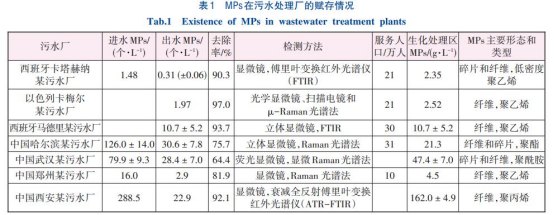
It can also be found from Table 1 that the concentrations of MPs in the influent of different sewage treatment plants vary considerably, which may be related to the population size served by the plants and their functional types. Overall, the removal efficiency of MPs by sewage treatment plants ranges from 55% to 97.8%, and the variation may be attributed to the different treatment processes adopted by individual plants. Sewage treatment plants generally have a three-stage treatment unit, among which the pre-treatment and primary treatment processes include screening, grit removal, oil skimming and so on. Screening mainly intercepts large-sized MPs, with the particle size retained depending on the screen size. High-density MPs are removed through physical sedimentation in the grit removal process, while oil skimming removes low-density MPs floating on the sewage surface, achieving a removal efficiency of up to 45%. The remaining MPs enter the secondary treatment unit, where the removal efficiency can generally reach 69%–80%. Nevertheless, approximately 16.9% of MPs still remain in the effluent of the secondary treatment. Kalčíková et al. verified through experiments on a sequencing batch biological wastewater treatment system that an average of 52% of microbeads are trapped in activated sludge. Studies have shown that most MPs entering the secondary treatment process come into contact with sludge, with electrostatic adsorption between flocculent sludge and MPs playing a dominant role, while a small portion floats in the aqueous phase. Although the vast majority of MPs in wastewater are removed with the discharge of excess sludge, the transfer of MPs from the aqueous phase to the sludge phase increases the risk of impacts on the subsequent treatment and disposal of sludge.
2. Influencing Factors of MPs on the Nitrogen Removal Process
2.1 Concentration
MPs concentration is one of the most important influencing factors for biological nitrogen removal. Studies by Song et al. have shown that compared with the control group, the addition of 10,000 particles/L of PVC-MPs can reduce the nitrification rate from the original 90.97% to 46.66%. However, Zheng et al. pointed out that when the concentration of PE-MPs increases from 20 particles/L to 200 particles/L, the nitrification reaction maintains a relatively stable state. Notably, when aerobic granular sludge (AGS) is exposed to PA66 at concentrations of 0, 0.1, 0.2 and 0.5 g/L, the ammonia nitrogen removal rate reaches a peak of 95.61% at the PA66 concentration of 0.2 g/L. This phenomenon has also been observed in studies on the effects of PS-MPs on AGS. He et al. found that when the concentration of PET-MPs gradually increases to 500 μg/L, the nitrate concentration in the effluent rises significantly, indicating that PET-MPs reduce the denitrification rate of the system. Li et al. investigated the effects of five different concentrations of MPs on the denitrification process and found that the increase in the concentrations of PP, polystyrene (PS) and polyester fiber (PES) promotes a continuous rise in the denitrification rate of activated sludge, whereas the increase in the concentrations of polyvinyl chloride (PVC) and PE leads to a downward trend in the nitrification rate of activated sludge. Hong et al. studied the effects of PET on anammox granular sludge, and the results showed that compared with the blank group, 0.1–0.2 g/L of PET-MPs has no significant effect on anammox sludge, while when the concentration rises to 1.0 g/L, the total nitrogen removal rate decreases by 4.2%.
2.2 Particle Size
For the same type of MPs, the particle size exerts varying impacts on the nitrogen removal process. He et al. found that the variation in PVC particle size has a significant effect on the ammonia oxidation rate—the larger the particle size, the lower the ammonia oxidation rate. This is because large-sized MPs impede the transport of dissolved oxygen, thereby inhibiting the activity of aerobic ammonia-oxidizing bacteria. However, other researchers discovered that the anammox nitrogen removal efficiency of systems dosed with 75 μm and 150 μm PET is lower than that of the control group, while systems dosed with 300 μm and 500 μm PET exhibit better anammox nitrogen removal performance than the control group. This may be due to the fact that MPs with smaller particle sizes have a lower zeta potential, making them more likely to diffuse around activated sludge and exert negative effects. He et al. also obtained similar findings: after adding PS with a particle size of 150–300 μm to activated sludge, the nitrate nitrogen removal rate is basically the same as that of the control group, whereas when the particle size decreases to 0–75 μm, the nitrate nitrogen removal rate drops to 56.18%.
2.3 Type
The surface properties and chemical structures of MPs also exert a certain impact on the nitrogen removal capacity of activated sludge. Miao et al. found that after surface modification, positively charged PS-NH₂ exhibits higher toxicity to microorganisms than negatively charged PS-COOH. This may be attributed to the fact that the cell surface is predominantly negatively charged; when in contact with positively charged PS-NH₂, MPs tend to penetrate into cells via electrostatic attraction, thereby exerting an inhibitory effect. Compared with biodegradable polybutylene succinate (PBS), anammox sludge is more sensitive to non-biodegradable PVC. The underlying reason might be that the ester bonds in PBS can be decomposed by various hydrolases and completely mineralized, whereas the numerous carbon-carbon single bonds in PVC are resistant to biological oxidation. In addition, some studies have revealed that PE, PVC and PES exert no significant differences in their impacts on the denitrification reaction in activated sludge. Furthermore, even for the same type of MPs, their surface properties may change due to solar irradiation, physical abrasion and other factors, which could exert varying degrees of influence on the biochemical treatment efficiency of sewage.
2.4 Density
The density of MPs may also affect the nitrogen removal capacity of microorganisms. Wang et al. discovered that there is a positive correlation between the density of MPs and the degree of inhibition on nitrification capacity. This is because MPs with higher density tend to settle and accumulate in the sludge, while those with lower density float on the water surface and flow out of the reactor.
2.5 Water Quality Composition
Other pollutants present in sewage, such as antibiotics, can bind to MPs through electrostatic adsorption, thereby exerting adverse effects on nitrogen-removing functional bacteria. Wang et al. found that the combination of PVC, PA and triclosan causes severe acute inhibition on nitrifying sludge, and even leads to the complete loss of nitrification function of the sludge after 14 days of operation, with the inhibition degree being much higher than that of their individual effects. Similarly, compared with the ammonia nitrogen removal rate of the control group (99.60%), the ammonia nitrogen removal rates decreased to 83.59%, 86.27%, 85.86% and 91.31% respectively when exposed to 10 mg/L of PVC, PA, PS and PE (each combined with 0.1 mg/L of tetracycline). However, Li et al. found that both the addition of tetracycline alone and the simultaneous addition of tetracycline and PVC-MPs caused a decrease in ammonia oxidation rate (by up to 20%), indicating that the addition of MPs did not cause additional toxic inhibition.
3. Impact of MPs on the Activity of Nitrogen-Removing Functional Bacteria
A statistical analysis was conducted on the impacts of MPs on the activity of nitrogen-removing functional bacteria such as AOB, NOB, DNB and anaerobic ammonia-oxidizing bacteria (AnAOB) as reported in relevant literatures, and the specific details are shown in Table 2.
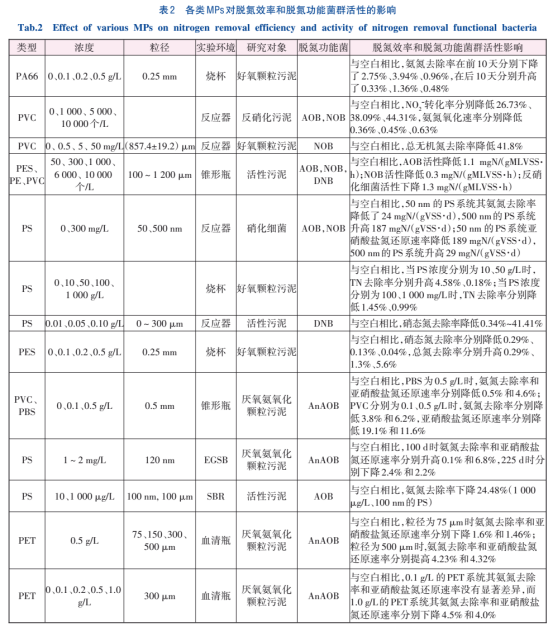
As can be seen from Table 2, different nitrogen-removing functional bacteria exhibit varying tolerance ranges to MPs, which depend on factors such as MP type, exposure duration, influent water quality, and reactor configuration. In addition, the vast majority of reports indicate that AOB, NOB, DNB and AnAOB are all susceptible to inhibition by MPs, suggesting that MPs possess universal cytotoxicity to these bacterial communities. Therefore, to maintain a high nitrogen removal rate and reaction activity, it is necessary to adopt pretreatment processes to remove MPs as much as possible before they enter the biochemical treatment system, so as to mitigate their inhibitory effects on the activated sludge treatment system.
4. Positive Impacts of MPs on Biological Nitrogen Removal
4.1 Antagonistic Effects of Influent Water Quality
Municipal sewage has a highly complex composition. MPs may exert a certain antagonistic effect with some other pollutants in wastewater, resulting in the attenuation or even elimination of their toxicity, thereby providing a degree of protection for nitrogen-removing microorganisms. Li et al. found that the separate addition of PVC-MPs and Cd²⁺ would both inhibit the denitrification rate to some extent, but the simultaneous addition of 1,000 particles/L of PVC-MPs and Cd²⁺ promoted the denitrification process.
4.2 Increased Zeta Potential
The surface of activated sludge is predominantly negatively charged. Therefore, the higher the absolute value of the Zeta potential on the MP surface, the stronger the electrostatic repulsion between MPs and activated sludge, resulting in no significant impact or even a promotional effect on biological nitrogen removal. Studies have shown that the addition of 500 nm PS particles to nitrifying bacteria can simultaneously increase the ammonia oxidation rate and nitrite utilization rate, whereas the addition of 50 nm PS particles leads to an inhibitory effect.
4.3 Expanded Colonization Space
As microbial carriers, MPs can form favorable microenvironmental conditions for nitrogen-removing bacteria, thereby promoting microbial adhesion and reproduction, which manifests as a certain positive effect. When the concentration of PVC increases from 1,000 particles/L to 5,000 particles/L, the k-value of the linear regression equation for zero-order denitrification reaction increases by 1.62. In addition, MPs, especially biodegradable MPs, can release dissolved organic carbon, which in turn promotes denitrification. The addition of MPs and the improvement of the microenvironment may also induce the adaptive reconstruction of microbial communities, reshape the original symbiotic patterns, and enable microorganisms to better adapt to the MP-exposed environment.
5. Negative Impacts of MPs on Biological Nitrogen Removal
5.1 Reduction and Destabilization of Extracellular Polymeric Substances (EPS)
EPS is a layer of substances secreted by cells outside the membrane, mainly consisting of polysaccharides, proteins, and humic substances. Microorganisms can spontaneously produce EPS to cope with adverse external environments. Studies have found that aerobic granular sludge (AGS) exposed to low concentrations (15 particles/L) of PET exhibits increases of 22.8%, 22.5%, and 21.3% in the contents of polysaccharides, lipids, and humic acids in EPS, respectively. However, when the concentration of PET-MPs increases to 75–300 particles/L, the contents of these three substances all show a downward trend, which is due to the fact that high concentrations of MPs damage the cell's self-protection system. Feng et al. used excitation-emission matrix (EEM) fluorescence spectroscopy and found that in the interaction between PS-NPs and EPS, the binding of PS-NPs to EPS alters the secondary structure of proteins in EPS, leading to a decrease in the bioflocculation capacity and stability of activated sludge, thus rendering it vulnerable to MP toxicants.
5.2 Oxidative Stress
The cell membrane is a thin film composed of phospholipids, proteins, and carbohydrates that surrounds the cell exterior; it can resist the invasion of foreign substances and prevent damage to intracellular components. Oxidative stress is an important mechanism by which MPs damage cell membranes. When cells encounter foreign substances, they activate a response mechanism, and reactive oxygen species (ROS) are released to promote oxidative stress, leading to changes in cell membrane permeability. When ROS levels are excessively high, the cell membrane develops wrinkles, pores, and cracks, which further damage organelles and cause functional impairment of cells. Reports have shown that the ROS levels of AGS increase by 9.2%, 12.5%, and 17.3% when exposed to 75, 150, and 300 particles/L of PET-MPs, respectively. Therefore, the degree of damage to nitrogen-removing functional bacteria can be indirectly characterized by measuring indicators such as ROS and their oxidation products (e.g., lactate dehydrogenase (LDH) and malondialdehyde (MDA)) in functional bacterial cells.
5.3 Physical Damage
Physical contact is another explanation for the damage of MPs to microbial cells. When MPs come into contact with cells, they can surround the cell membrane or embed in the cell wall, hindering the transfer of energy and nutrients between the cell and the external environment. Researchers observed via scanning electron microscopy (SEM) that after the addition of MPs, the particle size of AGS decreases and even fragmentation occurs. Long-term exposure to PET-MPs results in the clogging of pores in AGS that are responsible for nutrient and material transport. A simulation experiment found that when PS-NPs come into contact with phospholipid membranes, PS depolymerizes and dissolves in the phospholipid membranes, leading to changes in phospholipid membrane structure and deterioration of membrane protein activity. In addition, the physical damage to activated sludge caused by MPs due to mechanical friction induced by hydraulic shear force cannot be ignored, which will directly lead to cell rupture and death, especially in the presence of large-sized MPs. Large-sized MPs can also disrupt the normal structure of cells through collisions, resulting in functional inhibition or loss. In the secondary biochemical treatment process, the intense sludge-water mixing may exacerbate the adverse effects of MPs on biological nitrogen removal.
5.4 Decreased Enzyme Activity
Key enzymes involved in biological nitrogen removal mainly include ammonia monooxygenase (AMO), nitrate reductase (NAR), and nitrite reductase (NIR). In the anammox system, the addition of PVC inhibits the synthesis of genes (hzsA, hzsB, hzsC, and HAO) encoding hydrazine synthase and hydrazine dehydrogenase, leading to a decrease in nitrogen removal efficiency and thus hindering the anammox reaction. Ma et al. found that enzymes involved in nitrification (AMO, NXR) show significant inhibition at 10 mg/L of PS, while enzymes involved in denitrification (NAR, NIR) are inhibited by both 1 mg/L and 10 mg/L of PS.
6. Conclusions and Prospects
As an emerging pollutant in aquatic environments in recent years, MPs have been proven to have potential impacts on biological nitrogen removal in sewage treatment. Future research should be carried out in the following aspects:
Develop rapid identification and removal technologies for MPs in sewage to ensure the nitrogen removal efficiency of biochemical systems.
Establish analytical methods for the activity expression of different nitrogen-removing functional microorganisms in the presence of MPs.
Considering the complexity and variability of actual sewage water quality, further research is needed to explore the effects of the coexistence of MPs and other pollutants (e.g., refractory organics, heavy metals, and antibiotics) on nitrogen removal performance.
Adopt technologies such as metagenomics, metabolomics, and transcriptomics to investigate the impact mechanisms of MPs on the community structure and metabolic functions of nitrogen-removing microorganisms from a molecular biology perspective.